Key Architectural Takeaways
1. London Digital Ecosystem & High-Intent Organic Search Dynamics
London represents Europe's most competitive commercial search ecosystem. Financial institutions in the Square Mile, private equity firms in Mayfair, and software startups in Shoreditch contend daily for organic search visibility. In this saturated digital environment, commercial queries carry immense financial value. Generic SEO tactics like superficial blog posts cannot penetrate competitive search results pages. Enterprise brands in London require a sophisticated search strategy rooted in technical performance engineering and semantic data science.
DesignNCode approaches organic growth as an integrated software discipline rather than a superficial marketing exercise. We develop resilient search architectures that align server response latency, entity-based topical authority, and high-intent buyer journeys with algorithmic search ranking criteria. By synchronizing technical web development with commercial keyword intent, we establish sustained search visibility that consistently converts qualified prospects into high-ticket revenue. Discover how our dedicated SEO services unlock durable organic market advantages for UK businesses.
2. Technical SEO Architecture, Server-Side Rendering & Core Web Vitals
Modern search algorithms prioritize websites that deliver rapid, stable, and accessible user experiences. Sluggish legacy content management systems suffer from excessive JavaScript execution times, cumulative layout shifts, and delayed time to first byte. These technical bottlenecks trigger severe ranking penalties across Google mobile-first indexes. For London enterprises managing complex product catalogs or corporate portals, technical debt compromises organic keyword rankings and inflates bounce rates among executive decision makers.
Our engineering team builds high-performance digital platforms using Next.js server-side rendering and edge caching pipelines. Adhering to standards outlined in the official Next.js Documentation, we achieve perfect Core Web Vitals scores across Interaction to Next Paint and Largest Contentful Paint. Furthermore, all digital interfaces satisfy accessibility standards established by the W3C Web Accessibility Initiative. Combining custom web development services with performance auditing ensures search crawlers parse and index your key commercial assets instantaneously without rendering bottlenecks.
3. Generative Engine Optimization, LLM Citations & Vector Search Entities
The rapid ascent of generative artificial intelligence is transforming commercial discovery across the United Kingdom. Executive buyers and corporate procurement teams in London increasingly source vendor intelligence through AI systems like ChatGPT, Claude, Perplexity, and Google AI Overviews. These platforms extract information through semantic vector retrieval rather than traditional link graph analysis. Brands relying solely on outdated backlink profiles risk invisibility within conversational answers, losing market share to competitors whose web architectures are engineered for machine synthesis.
DesignNCode pioneers advanced Generative Engine Optimization strategies that position your company as the authoritative citation source for AI engines. We structure factual content into extractable information units, define explicit semantic relationships, and embed clear data points that large language models ingest with high confidence. By unifying our specialized UI/UX design services with dense knowledge representation, we guarantee your enterprise dominates both traditional search engine result pages and emergent AI conversational search interfaces across London.
| Architecture / Capability | Conventional SEO Agency | DesignNCode Modern Engineering |
|---|---|---|
| Technical & Rendering Core | Slow monolithic CMS themes plagued by script bloat and rendering lag | Sub-second Next.js edge architecture with perfect Core Web Vitals |
| GEO & Entity Optimization | Keyword stuffing ignoring semantic vector graphs and AI indexing | Structured vector entities and dense schema for LLM citations |
| Crawl Efficiency & Hierarchy | Generic sitemaps without log monitoring, wasting crawl budget | Dynamic edge routing and prioritized indexation for key URLs |
| Local & UK Compliance | Blanket location pages without regulatory safeguards or relevance | District entity graphs conforming to FCA Consumer Duty and UK GDPR |
4. Enterprise Knowledge Graphs, Linked Open Data & UK Regulatory Schema
Search engines interpret modern web content through interconnected entity graphs rather than isolated keyword strings. London financial institutions, legal partnerships, and healthcare providers must communicate organizational structure, professional accreditations, and regulatory standing through structured JSON-LD markup. Incomplete schema prevents search algorithms from understanding corporate hierarchies and geographic jurisdictions, thereby suppressing rich search results like knowledge panels, executive carousels, and localized organizational snippets across Google and Bing.
We engineer comprehensive schema markup architectures conforming to Schema.org standards and semantic web protocols. Our implementations explicitly define corporate relationships, service catalogs, and localized executive credentials for London enterprises. For businesses subject to financial governance, our schemas integrate transparent disclosures aligned with the Financial Conduct Authority (FCA). By combining programmatic schema validation with secure data flows audited under UK Information Commissioner's Office (ICO) rules, we transform your digital footprint into an interconnected, machine-readable knowledge authority.
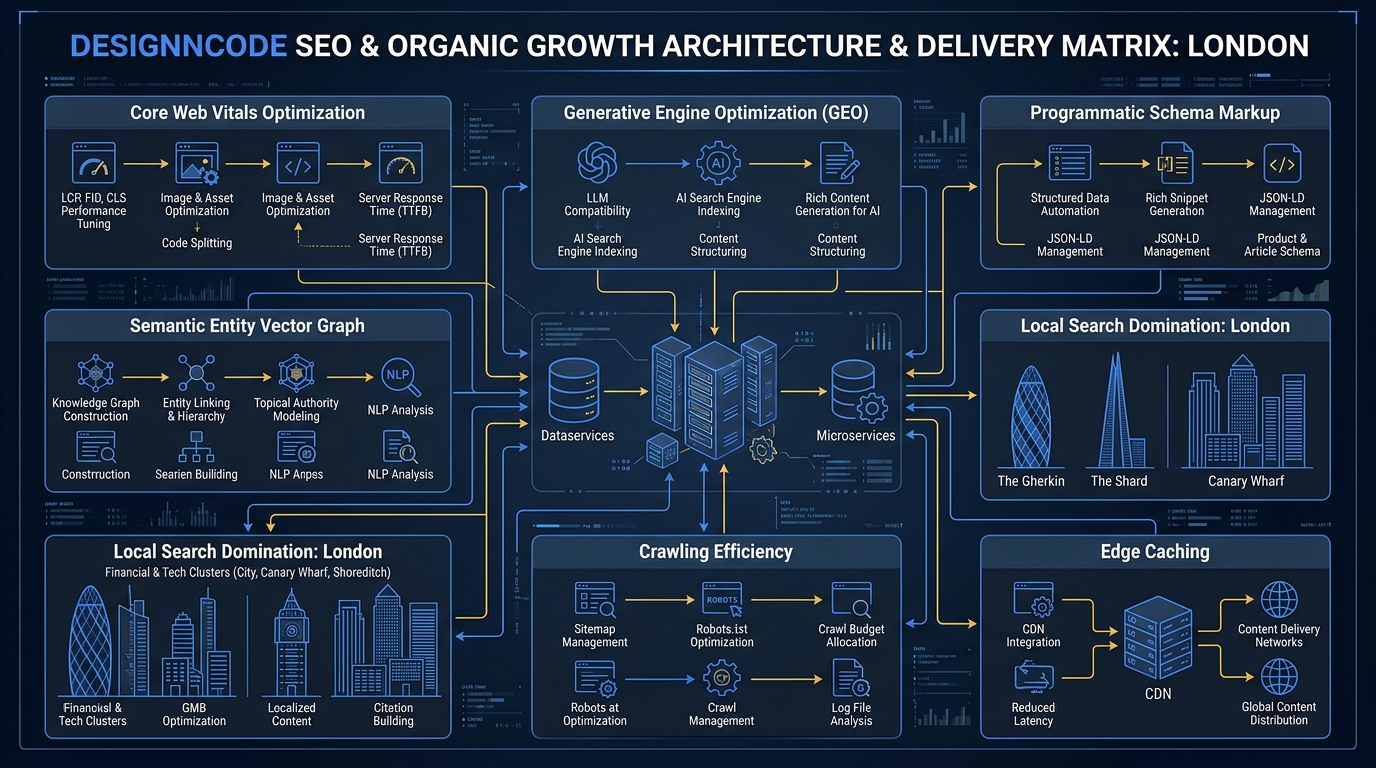
SEO & Organic Growth Architecture & Delivery Matrix: London
5. Hyper-Local Entity Domination Across Square Mile, Mayfair & Canary Wharf
London is not a monolithic market: it is a collection of hyper-specialized commercial districts with distinct search behaviors and industry concentrations. Institutional asset managers in the Square Mile target vastly different search intent than luxury fashion houses along Bond Street in Mayfair or fintech providers in Canary Wharf. Attempting to capture these disparate customer segments with generic city-level landing pages results in diluted topical relevance, poor local map pack rankings, and low organic conversion rates across distinct boroughs.
DesignNCode creates granular local search architectures tailored to specific London postal codes and business enclaves. We align Google Business Profiles, localized schema data, and geocoded entity references to establish undeniable relevance across target zones like EC2, W1, and E14. For luxury retailers, we integrate these localized search models with headless Shopify and e-commerce development backends. This targeted approach captures high-net-worth commercial demand directly within the physical neighborhoods where your ideal enterprise clients live and operate.
7. Edge Crawl Budget Optimization, Log File Auditing & Indexation Engineering
For large enterprise websites operating tens of thousands of dynamic URLs, crawl budget management represents a critical growth bottleneck. Search engine bots allocate finite computing resources to discover, crawl, and render website pages. When web servers respond with high latency or serve complex faceted navigation architectures, crawlers abandon sessions prematurely. Consequently, newly published commercial landing pages and critical product updates can languish unindexed for weeks, causing significant lost revenue in fast-moving market segments.
We implement edge server log file auditing and dynamic crawl prioritization connected through the London Internet Exchange (LINX) in Docklands. By analyzing server request patterns, our engineers eliminate redirect chains, purge orphan URLs, and structure automated XML sitemap feeds that direct Googlebot strictly to high-value commercial assets. Adhering to guidelines published by Google Search Central, we ensure maximum indexation velocity and minimal crawl resource waste across enterprise architectures.
8. Organic Conversion Engineering, Commercial Funnel Lift & Measurable ROI
Organic traffic volume is meaningless if it fails to generate measurable commercial outcomes. Many digital agencies celebrate keyword impression spikes while failing to deliver qualified leads or transactions. Enterprise growth demands an organic search architecture engineered from the ground up for conversion rate optimization. Every page layout, headline, interactive component, and call to action must guide executive prospects effortlessly from discovery to consultation, maximizing the commercial return on every organic visitor entering your digital ecosystem.
DesignNCode bridges the gap between search visibility and commercial revenue realization. We deploy behavioral analytics, interactive calculation widgets, and frictionless lead qualification funnels that turn organic search visitors into pipeline revenue. Review our featured projects to inspect how our technical implementations drive organic expansion. To partner with our senior leadership team, learn more about our team or contact our engineering team to schedule a confidential organic growth consultation.
Client Reviews: London
"DesignNCode completely re-engineered our technical SEO architecture across the City of London. Migrating to Next.js server-side rendering and deploying semantic entity schema boosted our organic search visibility by 160% in eight months, capturing top positions for high-value corporate restructuring queries."
Alistair Vance
Senior Partner, Vance & Kensington LLP (Square Mile, London)
"Scaling our fintech platform required an organic strategy built for generative search engines as well as traditional Google rankings. Ankita Malik and her engineering team implemented structured knowledge graphs and edge crawling protocols that doubled our qualified UK demo pipeline."
Helena Ross
Chief Marketing Officer, Finova Cloud Systems (Canary Wharf, London)
Frequently Asked Questions
Why is technical SEO essential for enterprise platforms in London?+
Technical SEO ensures search crawlers parse and index assets without latency. In London's market, sub-second page loads and clean server architecture provide the decisive advantage needed to outrank legacy competitors on high-value commercial queries.
How does Generative Engine Optimization differ from traditional keyword SEO?+
Traditional SEO focuses on keyword density and links. Generative Engine Optimization structures information for LLMs, embedding factual entities and schemas so platforms like ChatGPT cite your enterprise as an authoritative primary source.
How do you handle SEO for regulated financial services in the UK?+
We integrate compliance protocols aligned with FCA Consumer Duty and ASA CAP Code rules. Our architectures ensure clear risk disclosures and transparent metadata while maintaining high organic search relevance.
What role do Core Web Vitals play in Google search rankings?+
Core Web Vitals measure page speed, visual stability, and interaction latency. Sub-second performance via Next.js ensures your pages achieve top ranking eligibility while reducing bounce rates among executive visitors.
How does entity-based SEO improve local visibility across London boroughs?+
Entity-based SEO links digital properties to verified geographic coordinates and corporate registries. This deterministic structuring enables search engines to associate your business with commercial centers like Mayfair, Canary Wharf, and the Square Mile.
How do you optimize crawl budget for large-scale enterprise websites?+
We conduct server log analysis, eliminate duplicate loops, and deploy edge routing via LINX. This directs crawlers exclusively to high-margin URLs, indexing new content within hours rather than weeks.
How does UK GDPR compliance intersect with organic search analytics?+
UK GDPR and ICO directives require user consent before tracking behavior. We engineer zero-data-leakage analytics configurations collecting aggregate organic search telemetry without violating statutory privacy standards.
What timeline is expected for measurable enterprise organic search growth?+
Technical remediation and crawl optimization deliver indexation gains within four weeks. Substantial keyword ranking lift, AI citation growth, and high-intent pipeline expansion accelerate between months three and six as authority compounds.
Authoritative Sources & Citations
The regulatory, technological, and architectural standards referenced across this publication.
Technical guidance on search crawling, mobile indexation, and Core Web Vitals.
International technical standards governing accessible web interfaces and semantic markup.
Statutory rules for fair, transparent marketing across regulated UK digital platforms.
UK statutory governance regarding privacy, analytics consent, and electronic communications.
Technical network routing specifications for UK edge and carrier interconnection.
Architectural standards for server-side rendering and sub-second edge delivery.
