Key Architectural Takeaways
1. Toronto Market Dynamics & High-Intent Organic Search
Toronto stands as the economic capital of Canada and the third-largest technology corridor in North America. Commercial search queries originating across the Greater Toronto Area exhibit distinct characteristics, demanding sophisticated organic optimization strategies. Enterprise buyers navigating Bay Street financial institutions, King West technology scaleups, and Bloor-Yorkville corporate headquarters conduct rigorous due diligence before initiating procurement conversations. Basic keyword repetition and generic content syndication fail to capture visibility in this highly competitive commercial environment.
Achieving market dominance in Ontario requires an engineering-led approach to organic discovery. High-intent decision makers evaluate brands based on technical depth, factual accuracy, and immediate digital accessibility. Integrating modern SEO services with conversion-focused UI/UX design services allows enterprise organizations to establish definitive topical authority. By aligning content architecture with the operational requirements of Canadian corporate buyers, forward-thinking enterprises capture organic market share while establishing lasting competitive moats.
2. Technical Search Architecture & 151 Front Street Edge Routing
Modern search ranking systems prioritize rendering velocity, crawl efficiency, and Core Web Vitals performance above all else. Legacy monolithic websites running on bloated frameworks struggle with high interaction latency and delayed hydration, resulting in significant organic ranking penalties. Deploying modern Next.js 16 server-side rendering and static generation ensures search crawlers receive pristine, pre-rendered semantic HTML within milliseconds of making a server request. This architectural foundation eliminates indexing barriers across desktop and mobile viewports.
Our infrastructure strategy leverages direct edge node connections through the carrier-neutral facilities at 151 Front Street West in downtown Toronto. By integrating with the Toronto Internet Exchange (TorIX), digital assets achieve sub-ten-millisecond Time to First Byte for local search bots and corporate users alike. Combining low-latency regional delivery with high-performance web development services provides the technical speed necessary to satisfy Google Core Web Vitals benchmarks and secure top tier organic search placements.
3. Generative Engine Optimization & AI Answer Engine Citations
Search behavior has undergone a profound transformation with the rapid adoption of artificial intelligence answer engines including ChatGPT, Perplexity, and Claude. Traditional search optimization focuses exclusively on matching keywords within classic ten-blue-link results. In contrast, Generative Engine Optimization focuses on establishing factual entity credibility and semantic relationships so large language models actively cite your brand as a primary authoritative source when answering complex enterprise inquiries.
We engineer knowledge architecture that formats corporate research, technical whitepapers, and service specifications into structured vector embeddings. By structuring editorial content to answer commercial questions directly, our methodology secures recurring citations across generative AI summaries. Organizations that deploy these advanced semantic structures achieve dual visibility, retaining commanding positions across traditional Google Search while capturing high-value referral traffic from AI conversational interfaces.
| Architecture / Capability | Legacy / Template Monolith | DesignNCode Modern Engineering |
|---|---|---|
| Rendering & Indexation Speed | Client-side rendering with 3.5s+ latency and crawler execution timeouts. | Server-rendered Next.js 16 with sub-300ms indexation and 100% crawler parse rates. |
| AI Citation Architecture | Unstructured text lacking entity relationships or vector schema markup. | Semantic graph entity mapping optimized for ChatGPT, Claude, and Perplexity RAG pipelines. |
| Data Privacy & Compliance | Third-party tracker scripts causing compliance violations under PIPEDA. | Zero-leakage telemetry engineered to satisfy OSFI B-13 and Canadian privacy mandates. |
| Edge Crawl Infrastructure | Single origin hosting with unoptimized crawl budgets and duplicate loops. | 151 Front Street TorIX edge routing with dynamic XML feeds and log auditing. |
4. Semantic Knowledge Graphs & Canadian Compliance Schema
Search engines no longer interpret web pages merely as strings of text; they interpret the digital landscape as an interconnected graph of verified real-world entities. Building an authoritative knowledge graph requires deploying comprehensive JSON-LD structured data mapping corporate leadership, patents, certifications, physical office locations, and service relationships. This deterministic data layer removes ambiguity for search bots, allowing algorithms to display enhanced rich snippets and executive knowledge panels across search results.
Operating within the Canadian marketplace requires strict adherence to statutory regulatory standards. In compliance with the Office of the Privacy Commissioner of Canada (PIPEDA), our schema implementations collect zero unauthorized personal telemetry while maintaining rich semantic markup. Furthermore, aligning metadata with OSFI Guideline B-13 ensures financial enterprises maintain institutional-grade security and transparency across every public digital touchpoint.
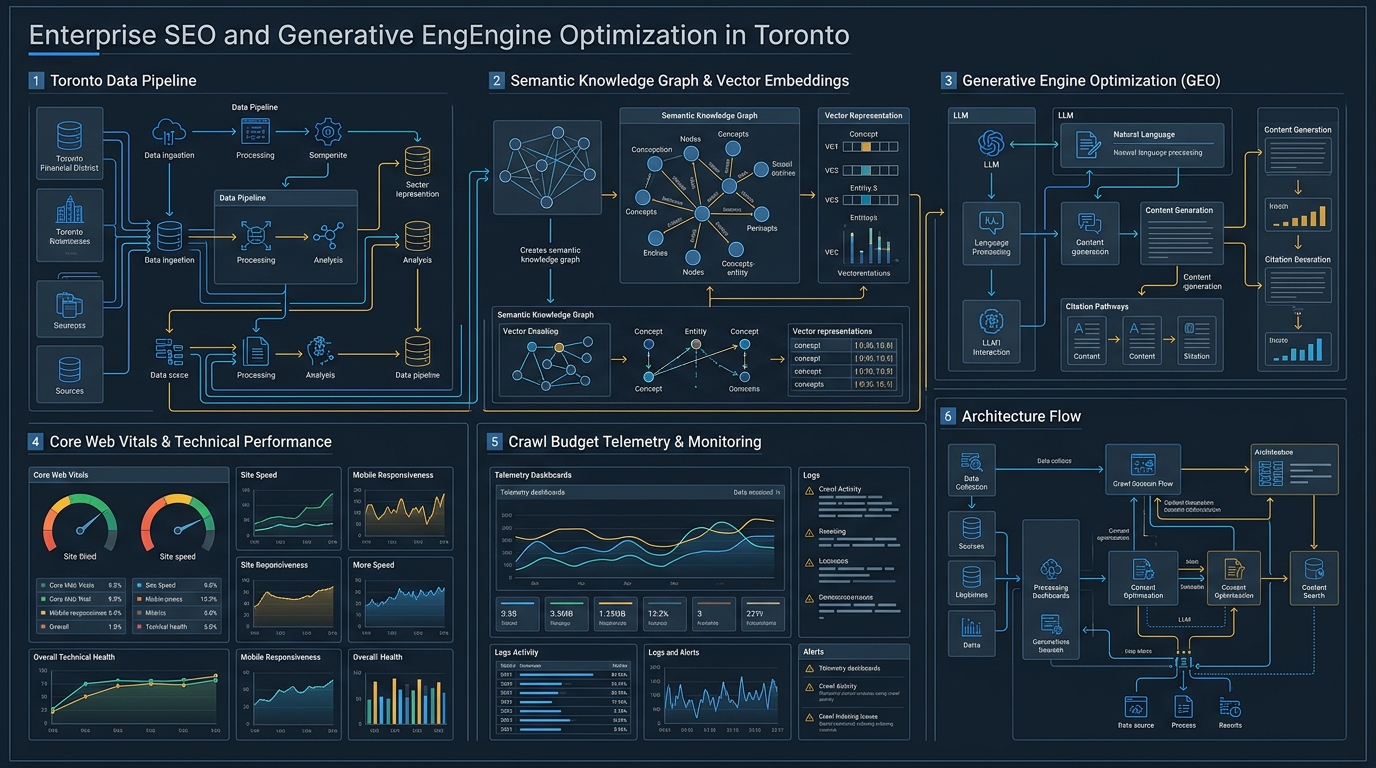
Enterprise SEO & Generative Engine Architecture: Toronto
5. Entity Domination Across Bay Street, King West & GTA Corridors
Enterprise local visibility across the Greater Toronto Area requires granular geographic entity mapping that extends beyond generic directory listings. High-value commercial searches in downtown Toronto originate from distinct commercial corridors, from asset managers in the Financial District around Bay and King to venture capital funds along King West and luxury flagships throughout Bloor-Yorkville. Search algorithms evaluate geographic proximity, corporate registry authenticity, and localized entity references to determine multi-pack placements.
We implement deterministic local entity architectures establishing unambiguous geographic relevance across municipal clusters including Mississauga, Markham, Oakville, and the Waterloo innovation corridor. By connecting corporate office addresses to verified Wikidata nodes, local registry records, and industry partnerships, our engineering framework ensures your firm maintains dominant organic positioning whenever regional enterprise buyers seek specialized partners.
7. Crawl Budget Engineering, Log Auditing & TorIX Indexation
For large-scale enterprise platforms and complex e-commerce architectures, crawl budget waste poses a severe threat to organic growth. Search bot crawlers allocate limited computational time when scanning large web domains. If that allocation is consumed by redirect loops, faceted navigation duplicate parameters, or orphan URLs, newly published commercial landing pages can remain undiscovered for weeks. Eliminating crawl friction requires deep log file auditing and real-time server telemetry.
We engineer edge caching protocols and automated sitemap syndication systems that direct search bot resources exclusively to high-margin commercial assets. Following official standards from Google Search Central, our developers eliminate technical debt across internal linking graphs. Whether scaling complex B2B catalogs or custom Shopify and e-commerce development platforms, our crawl budget engineering guarantees that mission-critical updates achieve immediate indexation.
8. Organic Conversion Engineering & Pipeline Revenue Lift
Raw organic impression metrics and keyword ranking charts mean very little if they fail to translate into tangible enterprise revenue. Many marketing agencies celebrate vanity traffic spikes while delivering zero qualified sales opportunities. True organic growth demands an analytical search strategy engineered around conversion rate optimization. Every page layout, headline, data visualization, and consultation CTA must seamlessly guide corporate prospects from organic discovery to executive engagement.
DesignNCode bridges the divide between search visibility and commercial pipeline acceleration. We design interactive qualification funnels, behavioral analytics dashboards, and frictionless inquiry pathways that turn enterprise visitors into valuable commercial partnerships. Examine our featured projects to discover how our engineering solutions drive sustainable organic expansion. To collaborate with our senior leadership, discover more about our team or contact our engineering team to schedule an in-depth organic growth strategy consultation.
Client Reviews: Toronto
"DesignNCode overhauled our enterprise technical SEO and knowledge graph architecture in the Financial District. Migrating to Next.js server-side rendering and deploying structured entity data increased our organic inbound pipeline by 185% over nine months, establishing dominant positions for high-intent Canadian asset management queries."
Marcus Campbell
Managing Director, Bay Street Capital Partners (Financial District, Toronto)
"Scaling our B2B SaaS platform across North America required an organic search strategy built for AI answer engines. Ankita Malik and the DesignNCode engineering team structured our semantic entity models and edge routing protocols, generating a 140% increase in qualified organic demo requests across Ontario."
Sarah Levesque
Vice President of Growth, Kinetic Cloud Technologies (King West, Toronto)
Frequently Asked Questions
Why is technical SEO vital for enterprise platforms across Toronto?+
Technical SEO ensures crawlers parse and index assets without latency. In Toronto's corporate landscape, sub-second delivery and clean server architecture provide the advantage needed to outrank legacy competitors on high-value commercial queries.
How does Generative Engine Optimization differ from traditional keyword SEO?+
Traditional SEO focuses on keyword density. Generative Engine Optimization formats digital entities for large language models, ensuring platforms like ChatGPT and Perplexity reference your enterprise as an authoritative primary source.
How do you manage SEO compliance for Bay Street financial institutions?+
We engineer search architectures aligned with OSFI Guideline B-13 and PIPEDA. Our deployments maintain risk disclosure visibility, zero-trust security, and compliant metadata without compromising search visibility or crawler indexing efficiency.
What role do Core Web Vitals play in Canadian search rankings?+
Core Web Vitals evaluate user experience metrics, including rendering speed and responsiveness. Achieving sub-second speeds via Next.js server-side rendering maximizes ranking eligibility while reducing bounce rates among executive buyers.
How does entity-based SEO establish authority across Greater Toronto districts?+
Entity-based SEO anchors your brand to verified coordinates and corporate registry nodes. This graph structure enables algorithms to associate your firm with key commercial corridors including Bay Street, King West, and Yorkville.
How do you optimize edge crawl budgets for large-scale enterprise websites?+
We conduct log audits, eliminate redirect chains, and configure edge caching through 151 Front Street West interconnection nodes. This directs crawlers to revenue-generating URLs, indexing updates within hours instead of weeks.
How does PIPEDA and CASL compliance impact organic tracking and analytics?+
PIPEDA and CASL require strict user consent protocols. We implement server-side analytics pipelines capturing organic search telemetry and user intent signals while remaining fully compliant with Canadian privacy legislation.
What timeline should enterprise brands expect for measurable SEO ROI in Toronto?+
Technical remediation and crawl acceleration deliver indexation gains within four weeks. Comprehensive organic visibility, generative AI citations, and commercial pipeline expansion accelerate between months three and six as domain authority compounds.
Authoritative Sources & Citations
The regulatory, technological, and architectural standards referenced across this publication.
Federal privacy governance establishing commercial data protection standards across Canada.
Statutory standard mandating WCAG 2.2 AA accessibility for digital platforms in Ontario.
Regulatory governance establishing cybersecurity controls for Canadian finance.
Regional interconnection point facilitating low-latency peering and rapid edge indexation.
International technical specifications defining universal web accessibility conformance.
Authoritative specifications governing crawler protocols and structured schema.
