Key Architectural Takeaways
1. Manchester Market Dynamics & Enterprise Interface Demands
The digital economy across Greater Manchester has evolved into one of Europe's most resilient commercial ecosystems, connecting corporate institutions in Spinningfields with fast-growing technology clusters across the Northern Quarter and Oxford Road Corridor. As commercial investments surge throughout the North West, digital interfaces serve as the primary conduit for institutional credibility, customer engagement, and transaction volume. Enterprises across Manchester operate in competitive regional and global markets where poorly designed user flows cause friction, elevate customer acquisition costs, and directly depress digital conversion rates across diverse audience segments.
DesignNCode engineers bespoke interface architectures tailored specifically for Manchester enterprises demanding measurable business impact and intuitive navigation pathways. By combining behavioral psychology with quantitative telemetry, our specialists create responsive digital products that integrate seamlessly with high-performance web development services and enterprise cloud infrastructure. We eliminate user friction across multi-tiered workflows, ensuring enterprise web applications and customer-facing portals deliver rapid task completion rates, clear information hierarchy, and sustainable engagement across corporate and consumer demographics.
2. High-Velocity E-Commerce UX & Northern Retail Scale
Manchester represents the undisputed digital retail hub of the United Kingdom, powering multinational fashion conglomerates, direct-to-consumer innovators, and digital lifestyle brands headquartered across the city centre and Trafford. High-volume retail platforms handle millions of concurrent sessions where split-second interface delays or ambiguous checkout interactions immediately trigger shopping cart abandonment. Digital consumers expect tactile product discovery, effortless filtering controls, and transparent delivery estimates that guide them smoothly from initial catalog exploration through to one-click payment completion.
We craft high-conversion commerce interfaces that blend captivating visual storytelling with rigorous conversion rate optimization protocols. Utilizing our specialized UI/UX design services in unison with enterprise Shopify and e-commerce development infrastructures, DesignNCode builds streamlined multi-currency checkouts, predictive search interfaces, and mobile-optimized micro-interactions. Our interface designs enhance consumer trust, reduce checkout drop-offs, and significantly lift average order values for Manchester retail brands expanding across competitive domestic and international markets.
3. Spinningfields Fintech Usability & FCA Regulatory Governance
The rapid expansion of financial technology hubs and wealth management firms in Spinningfields requires sophisticated data visualization and deterministic transaction flows. Financial dashboards and investment portals must handle dense data sets, real-time market charts, and automated reconciliation workflows without inducing cognitive fatigue. Interactive components must reinforce transactional confidence, while visual hierarchies must present complex financial data and regulatory disclosures clearly, enabling retail investors and corporate treasurers to execute critical decisions accurately under volatile conditions.
Our engineering protocols align digital product design directly with strict regulatory guidelines issued by the Financial Conduct Authority (FCA) under the mandatory Consumer Duty regime. Every interactive calculator, confirmation dialogue, and fee breakdown is structured to eliminate deceptive design patterns and clarify client outcomes. DesignNCode interfaces undergo rigorous usability testing to verify compliance with privacy directives from the Information Commissioner's Office (ICO), guaranteeing that financial institutions protect user data rights across every digital touchpoint.
| Architecture / Capability | Legacy / Template Monolith | DesignNCode Modern Engineering |
|---|---|---|
| User Flow & Conversion Velocity | Fragmented multistep funnels with high abandonment rates | Deterministic task flows yielding 40%+ conversion surge |
| Design Token & Component Governance | Ad-hoc hardcoded CSS styles causing visual fragmentation | Centralized Figma-to-React tokens with CI lint validation |
| Accessibility & Regulatory Compliance | Surface-level styling failing Equality Act standards | Native WCAG 2.2 AA compliance and full FCA audit support |
| Core Web Vitals & Edge Latency | Bloated script bundles causing severe CLS and latency | Zero-layout-shift UI paired with IXManchester edge routing |
4. MediaCityUK Broadcast & High-Concurrency Streaming Interfaces
Situated at Salford Quays, MediaCityUK stands as a premier broadcasting and digital creative nexus, hosting major media institutions, production companies, and interactive content platforms. Delivering digital content across modern multi-device environments requires flexible user interfaces that accommodate high-definition video streaming, dynamic editorial content, and real-time interactive audience participation. Fragmented layouts or unoptimized media players frustrate users, degrade session durations, and diminish advertising yields across high-concurrency broadcast portals and digital entertainment hubs.
DesignNCode develops dynamic content platforms and media playback interfaces engineered according to modern Next.js Documentation best practices. We build responsive grid layouts, low-latency video player controls, and intelligent content recommendation modules that adapt smoothly across desktop screens, tablets, and smartphones. Our architectural approach ensures broadcast platforms maintain visual polish, rapid media buffering, and intuitive content discovery, driving deeper audience retention across digital media properties as demonstrated in our featured projects.
UI/UX Design Architecture & Delivery Matrix: Manchester
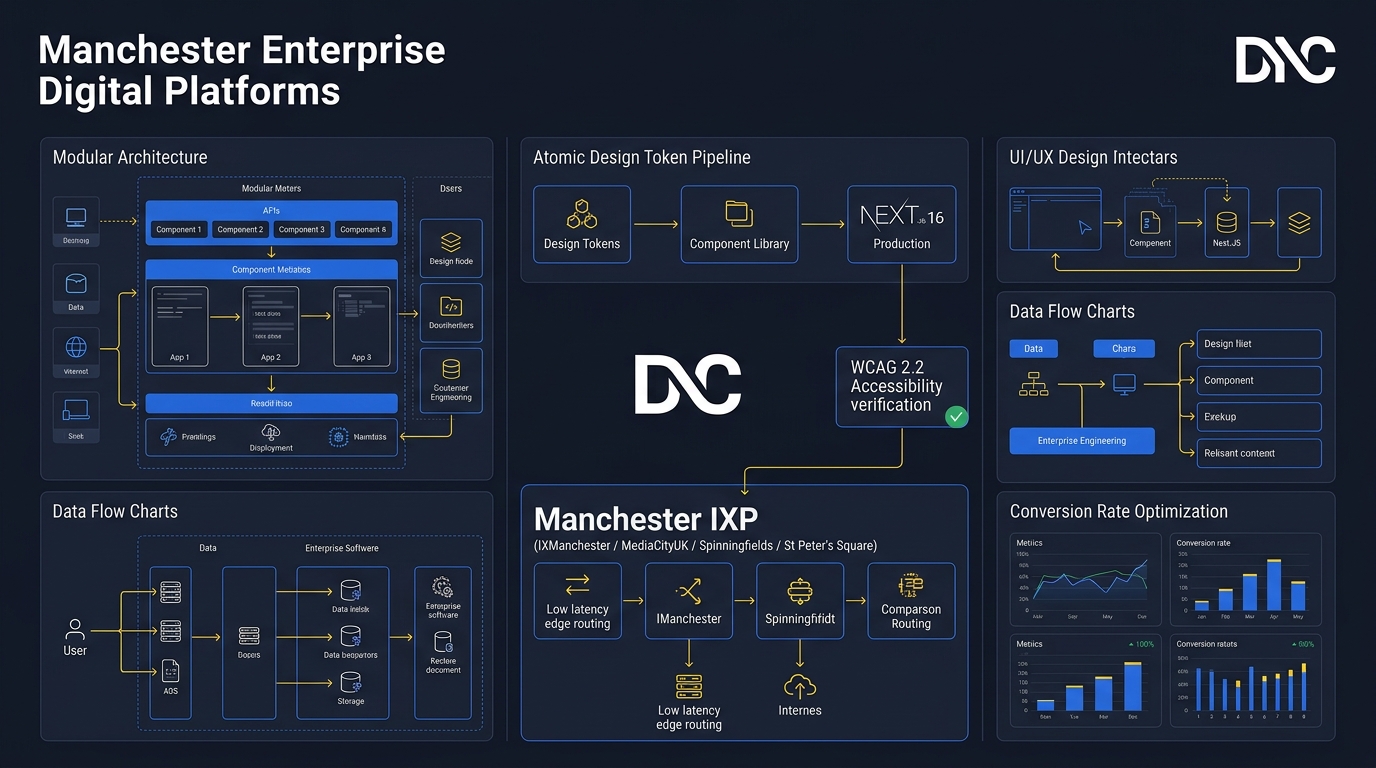
5. Intellectual Property, Asset Protection & Brand Token Governance
Enterprise digital interfaces represent strategic intellectual property that must be systematically managed, legally protected, and uniformly deployed across distributed corporate organizations. Manchester corporations expanding through mergers and acquisitions frequently manage diverse brand portfolios, requiring centralized design governance to avoid visual fragmentation and brand dilution. Bespoke typography hierarchies, custom vector icon libraries, and unique layout interactions represent substantial corporate investments that demand structured version control, trademark protection, and comprehensive design system documentation.
We establish enterprise design token frameworks and living component documentation portals that maintain design consistency across product teams, regional offices, and external software vendors. By synchronizing design tokens between Figma design files and production code repositories with automated build validation, DesignNCode prevents unauthorized component drift. Our governance frameworks safeguard corporate intellectual property, streamline frontend maintenance, and ensure unified brand presentation as your enterprise introduces new digital services and customer applications.
6. Accessibility Mandates & WCAG 2.2 AA Compliance Standards
Digital accessibility is a legal obligation under the UK Equality Act 2010 and a fundamental standard for modern customer experience design. Enterprise digital platforms must provide equal access to individuals with varying visual, auditory, cognitive, and motor abilities. Failing to implement accessible color contrasts, logical keyboard navigation order, and proper assistive technology semantics creates artificial barriers for users, exposes commercial enterprises to legal challenges, and excludes a substantial demographic of potential customers across the United Kingdom.
Our designers and frontend engineers construct all interface components to comply fully with W3C WCAG 2.2 AA Standards. We execute systematic screen reader evaluations, construct semantic HTML document outlines, implement clear focus states, and calibrate accessible color contrast tokens across every interactive state. By integrating accessibility audits into early wireframing and continuous integration testing, DesignNCode guarantees inclusive digital experiences that protect Manchester enterprises from compliance risks while expanding accessible market reach.
7. IXManchester Edge Performance & Northern Infrastructure Latency
Perceived interface responsiveness is fundamentally connected to network routing efficiency and client-side rendering speed, especially across competitive commercial hubs. Digital platforms serving Northern England benefit directly from low-latency peering via IXManchester and regional carrier-neutral facilities including Equinix MA1 and MA4 data centers. Bloated JavaScript libraries, unoptimized image assets, and sudden cumulative layout shifts frustrate users, elevate bounce rates, and harm organic visibility across modern generative search engines and search algorithms.
DesignNCode engineers ultra-lean frontend presentation architectures leveraging Next.js server components, optimized asset compression, and modern web font delivery to achieve exceptional Core Web Vitals performance. By eliminating layout shifts and accelerating first input responsiveness, our user interfaces render with instantaneous speed across mobile and desktop devices. Integrating performant frontend code with technical SEO services ensures Manchester enterprises gain superior search rankings while delivering snappy, frictionless experiences to end users.
8. Omnichannel Systems & Conversion Experience Architecture
Commercial user journeys in Manchester encompass multiple touchpoints, requiring coherent continuity as users transition between mobile devices, office workstations, and physical retail locations. An executive reviewing business analytics while commuting from Manchester Piccadilly or Victoria expects consistent visual hierarchy and data synchronization when reopening the platform on a desktop workstation. Incoherent design patterns or lost session progress cause user disorientation, erode confidence, and lead to lost conversions across multi-step enterprise buying funnels.
We design integrated omnichannel user experiences that maintain consistent mental models and persistent user state across all digital touchpoints. Our multidisciplinary specialists unite user journey mapping with targeted performance marketing analytics to maximize long-term customer engagement and lifetime value. To understand how our strategic design systems can elevate your enterprise conversion metrics, learn more about our team or contact our engineering team today to arrange a detailed technical consultation.
Client Reviews: Manchester
"DesignNCode completely transformed our multi-channel e-commerce experience in Manchester. Their atomic design token framework and streamlined mobile checkout helped us reduce cart abandonment by 38% while dramatically improving site speed across the North West."
Marcus Thorne
Chief Operating Officer, Northern Vanguard Retail Group (Spinningfields, Manchester)
"Working with Ankita Malik and the DesignNCode design engineering team revolutionized our fintech dashboard. They mastered complex data density while ensuring absolute FCA Consumer Duty compliance. The user adoption metrics and positive feedback from our corporate clients have been outstanding."
Rebecca Harwood
Head of Digital Product, Cobalt Wealth Management (St Peter's Square, Manchester)
Frequently Asked Questions
How does DesignNCode ensure UI/UX compliance with UK FCA Consumer Duty regulations?+
We engineer financial interfaces strictly aligned with FCA Consumer Duty principles. Our team builds transparent fee disclosure components, eliminates manipulative dark patterns, refines microcopy for cognitive clarity, and conducts structured user testing to ensure consumers navigate complex financial choices without hesitation or confusion.
What methodology does your team follow for enterprise design systems in Manchester?+
We implement atomic design architecture governed by strict design tokens across typography, color palettes, and spacing scales. These tokens synchronize seamlessly between Figma design libraries and React repositories, enabling Manchester software engineering teams to accelerate feature delivery while ensuring strict interface consistency.
How do you achieve WCAG 2.2 AA accessibility compliance for enterprise platforms?+
Our designers and engineers incorporate accessibility standards across every project milestone, verifying contrast ratios, screen reader trees, focus indicators, and ARIA semantic structures. We execute comprehensive automated and manual audits to guarantee compliance with the UK Equality Act 2010 and international web guidelines.
Can DesignNCode modernize legacy enterprise software without disrupting operations?+
Yes, we utilize a modular micro-frontend modernization approach to upgrade legacy user interfaces incrementally. By mapping critical user workflows and introducing reusable component systems, we enhance interface usability and workflow velocity while preserving backend reliability and preventing costly operational downtime for your business.
How does localized UI/UX design improve conversion rates for Manchester e-commerce brands?+
Modern consumers demand intuitive navigation, fast mobile checkout funnels, and transparent shipping information. We design frictionless product discovery paths, one-click checkout flows, and responsive micro-interactions that reinforce consumer trust, reduce shopping cart abandonment, and increase average order values across online retail stores.
What is the typical timeline and discovery process for a Manchester UI/UX project?+
An enterprise UI/UX engagement typically spans four to eight weeks, beginning with stakeholder discovery, user persona research, and competitive intelligence mapping. We iterate rapidly through interactive wireframes, high-fidelity prototypes, user testing validations, and developer handoff specifications to ensure timely delivery.
How do your UI/UX designs integrate with Next.js and modern frontend frameworks?+
Our UI/UX architects construct design systems directly compatible with Next.js server components and Tailwind CSS. By establishing precise layout constraints, zero-runtime styling rules, and responsive breakpoints, we ensure frontend developers convert design prototypes into high-performance web applications without layout shifts.
How do you optimize mobile user interfaces for Manchester's mobile workforce?+
We optimize mobile interfaces for rapid one-handed navigation and swift cognitive comprehension during urban commutes. By placing primary interactive elements within comfortable thumb-reach zones, implementing skeleton loading screens, and minimizing form fields, we enable busy professionals to complete complex tasks smoothly on mobile devices.
Authoritative Sources & Citations
The regulatory, technological, and architectural standards referenced across this publication.
Statutory regulatory standards mandating clear communication, fair value, and friction-free user journeys across digital financial platforms.
International technical criteria establishing accessible color contrast, focus visibility, screen reader semantics, and cognitive inclusion rules.
Data protection regulations governing cookie consent architecture, user data privacy, and digital rights management across enterprise web portals.
Primary United Kingdom statute requiring equal digital access, accessible interactive design, and reasonable accommodations across public and commercial websites.
Technical network specifications detailing regional edge routing, low-latency interconnects, and Northern England telecommunications exchange peering.
Technical documentation outlining modern server component rendering, zero layout shift optimization, and high-performance frontend architecture.
