Key Architectural Takeaways
1. Toronto Market Dynamics & Enterprise Interface Demands
Toronto functions as Canada's primary commercial engine and North America's third-largest financial technology ecosystem. From institutional banking headquarters towering over Bay Street to high-growth software scaleups clustered in King West and Liberty Village, the demand for enterprise digital experiences has never been more urgent. Enterprise buyers, institutional asset managers, and digitally native Canadian consumers evaluate corporate credibility through interface responsiveness, visual clarity, and transactional friction. When web platforms present clunky user journeys or inconsistent navigation patterns, user abandonment escalates rapidly, inflicting severe damage on customer acquisition pipelines and enterprise valuations.
DesignNCode delivers human-centric user interface and experience systems engineered specifically for the competitive Toronto metropolitan market. By synthesizing behavioral psychology, quantitative conversion data, and modular architecture, our design team builds robust digital products that pair seamlessly with high-performance web development services and scalable cloud systems. We eliminate navigational roadblocks across multifaceted digital portals, ensuring enterprise web applications and customer-facing workflows deliver effortless usability, rapid task completion rates, and sustainable commercial conversion growth across Canadian and international market segments.
2. Bay Street Fintech Usability & OSFI Regulatory Standards
The concentration of capital across Toronto's Financial District creates stringent interface requirements for wealth management dashboards, institutional lending exchanges, and algorithmic trading systems. Financial applications must present high-density transactional data with absolute clarity, ensuring users execute mission-critical trades or evaluate balance sheets without cognitive fatigue. Micro-interactions must convey explicit state confirmations, while typographic hierarchies must distinguish critical alerts from standard data tables under high-stress market conditions. Superficial visual styling without deep information architecture fails instantly in this demanding regulatory environment.
Our user experience frameworks adhere strictly to regulatory directives established by the Office of the Superintendent of Financial Institutions (OSFI) and the federal privacy mandates of the Office of the Privacy Commissioner of Canada (PIPEDA). We engineer deterministic transactional flows, transparent disclosure mechanisms, and robust multi-factor verification interfaces. Through rigorous user testing with active market participants, DesignNCode constructs enterprise interfaces that satisfy stringent compliance audits while empowering financial institutions to onboard high-value accounts with total trust and operational efficiency.
3. Bloor-Yorkville Luxury Prestige & Sensory Digital Craft
Flagship luxury boutiques, bespoke private family offices, and upscale hospitality brands lining Bloor-Yorkville's Mink Mile require digital experiences that reflect the prestige and tactile sophistication of physical flagships. High-net-worth consumers expect understated elegance, balanced spatial proportions, and refined micro-interactions that communicate exclusivity. Off-the-shelf templates and generic design libraries dilute brand equity, failing to project the heritage, craftsmanship, and institutional longevity demanded by discerning clientele in Toronto and international wealth hubs.
We design sensory digital environments that honor premium brand heritage while optimizing high-ticket conversion pathways. Combining bespoke UI/UX design services with customized Shopify and e-commerce development architecture, DesignNCode translates luxury brand storytelling into seamless digital interactions. Our meticulous spatial layouts, hardware-accelerated transitions, and curated typography scales evoke emotional resonance, reinforcing premium pricing power and cultivating lasting loyalty among high-value Canadian consumers and global luxury collectors.
| Architecture / Capability | Legacy / Template Monolith | DesignNCode Modern Engineering |
|---|---|---|
| User Flow & Task Velocity | Convoluted multistep funnels with high friction and abandonment | Deterministic task flows delivering 40%+ conversion surge |
| Design Token & Component Governance | Hardcoded ad-hoc CSS styles creating visual fragmentation | Centralized Figma-to-React tokens with CI lint validation |
| Accessibility & Legal Compliance | Superficial color styling failing mandatory AODA audits | Native WCAG 2.2 AA architecture insulating from legal liability |
| Core Web Vitals & Edge Latency | Bloated script bundles causing severe CLS and rendering lag | Zero-layout-shift UI paired with 151 Front Street West TorIX edge |
4. King West & Waterloo Scaleup Velocity & Atomic Design Tokens
The technology corridor stretching from King Street West and MaRS Discovery District to the Waterloo innovation basin demands exceptional product release velocity and modular interface scalability. High-growth software ventures backing enterprise SaaS, AI automation, and clean tech solutions must ship new features rapidly without accumulating frontend architectural debt. When development teams build disparate interface elements without centralized design token governance, component divergence multiplies, increasing refactoring costs and introducing jarring inconsistencies into user workflows.
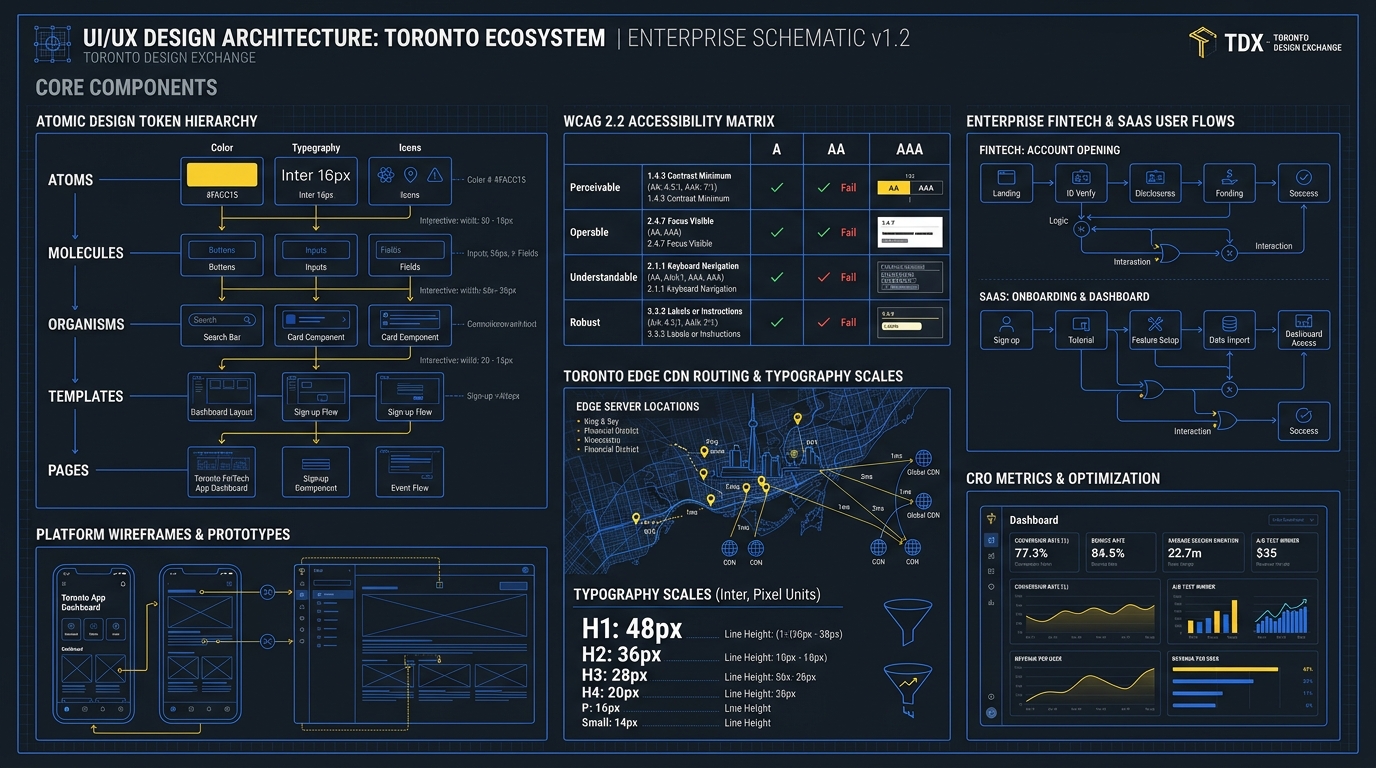
DesignNCode constructs resilient atomic design systems powered by continuous token pipelines connecting Figma design libraries with Next.js Documentation production codebases. Our structured component systems define strict tokens for typography hierarchies, color themes, spacing units, and responsive breakpoints. This architectural clarity empowers software engineering teams to accelerate sprint cycles, maintain immaculate visual consistency, and scale product portfolios seamlessly as demonstrated across our featured projects in competitive technology markets.
UI/UX Design Architecture & Delivery Matrix: Toronto
5. Brand Intellectual Property & Enterprise Design Governance
Enterprise digital interfaces represent valuable intellectual property assets requiring structured documentation, centralized governance, and cross-team alignment. Large corporations headquartered in Toronto oversee diverse product ecosystems and regional subsidiaries, necessitating unified design governance to prevent brand fragmentation and trademark erosion. Proprietary component patterns, custom iconography sets, bespoke typography systems, and patented interaction models constitute significant corporate capital investments that demand systematic version control and governance infrastructure.
We establish enterprise design system repositories and interactive documentation portals that maintain uncompromising visual and behavioral standards across internal engineering squads, external agencies, and third-party vendors. Integrating automated token linters and visual regression tests into continuous deployment pipelines ensures DesignNCode platforms eliminate component drift. Our governance frameworks safeguard intellectual property, preserve brand integrity across multinational touchpoints, and provide stable digital foundations as Toronto enterprises expand their market presence.
6. Accessibility Mandates, Accessible Canada Act & WCAG 2.2 AA
Digital accessibility in Ontario is both a moral commitment and a strict statutory obligation under the Accessibility for Ontarians with Disabilities Act and the Accessible Canada Act. Commercial platforms must deliver barrier-free navigation for users across visual, auditory, motor, and cognitive spectrums without sacrificing aesthetic elegance. Organizations failing to implement accessible contrast ratios, semantic page layouts, and complete keyboard navigation expose themselves to legal challenges, significant financial penalties, and the exclusion of millions of Canadian users who rely on accessible digital technologies.
Our design architects build every digital experience to surpass W3C WCAG 2.2 AA Guidelines and Ontario AODA Accessibility Standards. We execute comprehensive screen reader validations, structure accessible ARIA landmarks, verify focus indicators, and implement high-contrast color token palettes. By embedding accessibility compliance directly into initial wireframes and automated frontend test suites, DesignNCode shields Toronto enterprises from legal liabilities while expanding universal market reach.
7. 151 Front Street West & Low-Latency UI Routing Architecture
User experience is deeply intertwined with frontend rendering velocity and network edge latency, particularly in high-density corporate corridors where sub-second responsiveness directly governs engagement. In Toronto, enterprise platforms depend on localized edge delivery routed through carrier-neutral facilities at 151 Front Street West and the Toronto Internet Exchange (TorIX). Unoptimized JavaScript bundles, unstable layout shifts, and heavy web assets frustrate users, increase bounce rates, and degrade algorithmic search engine rankings across modern generative discovery platforms.
DesignNCode architects lightweight frontend presentation layers utilizing React server components, zero-runtime CSS abstractions, and responsive image compression to achieve flawless Core Web Vitals. By eliminating cumulative layout shift (CLS) and optimizing largest contentful paint (LCP), our interfaces render instantaneously across mobile and desktop environments. Synchronizing high-performance UI engineering with tailored SEO services ensures Toronto enterprises capture high-intent search traffic while offering fluid responsiveness to demanding enterprise users.
8. Omnichannel Commerce Architecture & Data-Driven UX Strategy
Contemporary Toronto consumer and enterprise journeys span diverse physical and digital surfaces, requiring coherent continuity between flagship physical locations, mobile devices, and enterprise portals. A corporate executive evaluating investment analytics on an office workstation expects the identical logical clarity and real-time state synchronization when accessing mobile interfaces during transit on the UP Express or TTC subway. Incongruous navigation models between touchpoints create user friction, erode brand trust, and suppress conversion rates across multi-step purchasing journeys.
We formulate unified omnichannel UX architectures that synchronize user mental models across all digital touchpoints, preserving session continuity and simplifying complex workflows. Our multidisciplinary strategists combine granular user path analytics with high-impact performance marketing methodologies to maximize lifetime customer value. To discover how our strategic interface architecture can elevate your enterprise conversion performance, explore about our team or contact our engineering team today for an executive design consultation.
Client Reviews: Toronto
"DesignNCode overhauled our institutional wealth management platform on Bay Street. Their masterclass in data density, AODA compliance, and rapid user workflows enabled us to reduce investor onboarding drop-offs by 44% while receiving glowing endorsements from our tier-one enterprise partners across Canada."
Marcus Campbell
Chief Technology Officer, NorthBridge Capital (Bay Street, Toronto)
"Launching our flagship luxury e-commerce experience from Bloor-Yorkville required immaculate visual aesthetics and lightning-fast mobile responsiveness. Ankita Malik and her engineering squad engineered an atomic design system that doubled our checkout completion rate while preserving our high-end brand ethos."
Sophie Tremblay
VP of Digital Experience, Maison Aurèle (Bloor-Yorkville, Toronto)
Frequently Asked Questions
How does DesignNCode ensure UI/UX compliance with Ontario AODA regulations?+
We engineer digital interfaces to meet strict Accessibility for Ontarians with Disabilities Act mandates and W3C WCAG 2.2 AA standards. Our team validates color contrast ratios, screen reader accessibility trees, keyboard navigation sequences, and ARIA attributes across all design iterations to eliminate legal exposure and ensure universal usability.
What methodology does your team follow for enterprise design token systems in Toronto?+
We implement an atomic design architecture governed by automated design tokens across typography, color palettes, and component layouts. These tokens synchronize continuously between Figma workspaces and production Next.js repositories, empowering distributed engineering teams across Toronto to ship software rapidly while maintaining absolute visual coherence.
How do your UI/UX solutions support high-security Bay Street financial institutions?+
Our architects design high-density financial dashboards with deterministic transaction confirmations, multi-factor authorization flows, and crystal-clear data hierarchies. We adhere strictly to OSFI regulatory standards and PIPEDA data privacy principles, ensuring sensitive financial workflows remain intuitive, fully auditable, and resilient under high transaction volume.
Can DesignNCode modernize legacy enterprise software without operational disruption?+
Yes, we apply a modular micro-frontend redesign framework that incrementally modernizes legacy workflows. By mapping mission-critical user paths and deploying isolated design system components, we upgrade user velocity and visual presentation without requiring risky full-system overhauls or causing service downtime.
How does custom UI/UX design elevate conversion rates for Toronto luxury brands?+
Luxury shoppers in Yorkville expect refined digital experiences that mirror physical boutique hospitality. We craft bespoke typography scales, intentional whitespace balance, and fluid micro-interactions that elevate brand perception, reinforce premium pricing power, and streamline high-ticket consultation and checkout journeys.
What is the typical timeline and discovery process for a Toronto UI/UX project?+
An enterprise engagement typically spans four to eight weeks, commencing with stakeholder discovery, persona profiling, and competitive research across Canadian submarkets. We then progress rapidly through interactive wireframes, validated prototypes, usability testing, and complete developer handoff documentation.
How do your design systems integrate with modern Next.js and frontend stacks?+
Our UI/UX deliverables translate directly into React server components and Tailwind CSS utility classes. By defining strict layout boundaries, responsive breakpoints, and zero-runtime style tokens, we ensure development teams implement production interfaces with zero layout shifts and top Core Web Vitals.
How do you optimize mobile user interfaces for busy Toronto corporate professionals?+
We optimize mobile navigation for one-handed thumb reach and instantaneous visual processing during urban commutes along the TTC subway or GO Transit network. By streamlining multi-field forms, adding optimistic UI states, and reducing cognitive overhead, we enable swift task completion on the go.
Authoritative Sources & Citations
The regulatory, technological, and architectural standards referenced across this publication.
Provincial statutory legislation mandating accessible digital communications, WCAG compliance standards, and barrier-free information architectures.
International technical specifications governing color contrast ratios, keyboard accessibility trees, focus visibility, and cognitive inclusivity.
Federal legislative framework regulating electronic privacy, user consent architectures, and customer personal data protection standards.
Federal regulatory authority setting operational resilience and digital technology risk management standards for Canadian financial institutions.
Carrier-neutral interconnect specifications detailing routing topologies and low-latency network peering at 151 Front Street West.
Performance framework documentation establishing server-rendered interface paradigms, layout stability, and asset delivery optimization.
