Key Architectural Takeaways
1. Toronto Market Dynamics & Enterprise Web Engineering Demands
Toronto stands as Canada's dominant economic capital and North America's fastest-growing technology corridor, where multinational financial conglomerates along Bay Street operate alongside hyper-growth software ventures in King West and Liberty Village. Enterprise web infrastructure across the Greater Toronto Area must process high transactional volumes, maintain uncompromised data integrity, and provide flawless digital customer interactions. Monolithic legacy software and poorly configured content management systems introduce dangerous latency bottlenecks, elevate hosting expenses, and fail to satisfy stringent Canadian compliance mandates for forward-thinking organizations.
DesignNCode architects modern full-stack web platforms engineered specifically for Toronto organizations seeking decisive market leadership. By combining Next.js 16 server components with resilient cloud microservices, our senior developers build high-throughput applications that integrate cleanly with enterprise resource planning tools, customer databases, and payment gateways. We eliminate architectural debt and modernize user touchpoints, ensuring corporate systems achieve unmatched operational efficiency. Explore our specialized web development services to discover our engineering methodologies.
2. Next.js 16 Edge Architecture & 151 Front Street Low-Latency Routing
Modern enterprise web platforms in Toronto demand frontend architectures that minimize browser execution overhead while delivering dynamic, real-time interactivity. Utilizing the Next.js App Router and React Server Components, our team moves intensive computation from client devices to geographically distributed edge networks. This design pattern reduces initial bundle payloads, accelerates Time to First Byte, and eliminates cumulative layout shifts, ensuring corporate portals render instantaneously across enterprise desktop workstations and mobile devices throughout Ontario.
We deploy production web assets directly to low-latency edge caches connected to the carrier-neutral facilities at 151 Front Street West and the Toronto Internet Exchange (TorIX). By optimizing network routing pathways across major Canadian telecommunication backbones and utilizing automated Brotli asset compression, our builds achieve consistent sub-100ms response benchmarks. Following official Next.js Documentation standards, we empower Toronto organizations to attain flawless Core Web Vitals scores.
3. Bay Street Fintech Systems, OSFI B-13 & Zero-Trust Security Protocols
As the epicenter of Canadian banking and capital markets, Bay Street financial institutions, asset managers, and fintech innovators require web applications engineered with zero-trust security foundations. Financial platforms cannot tolerate unhandled runtime exceptions, vulnerable third-party dependencies, or session hijacking vectors. Customer identity verification, multi-factor authentication handshakes, and ledger transaction pipelines must execute deterministically during volatile trading windows. Client-side interfaces must protect sensitive consumer data against cross-site scripting attacks and automated scraping bots.
Our software engineering team aligns every production release with cybersecurity guidelines established by the Office of the Superintendent of Financial Institutions (OSFI) under Guideline B-13. We implement strict Content Security Policies, cryptographic session storage, and comprehensive audit logs. Furthermore, our data collection workflows adhere to the Personal Information Protection and Electronic Documents Act (PIPEDA), giving Toronto financial institutions total regulatory confidence.
| Architecture / Capability | Legacy / Template Monolith | DesignNCode Modern Engineering |
|---|---|---|
| Core Web Vitals & Edge Latency | Bloated script bundles with slow server response times and high layout shifts | React Server Components and TorIX edge routing delivering sub-100ms loads and zero CLS |
| Regulatory & Security Governance | Vulnerable plugins with inadequate PIPEDA consent logging and OSFI risk exposure | Zero-trust session controls, deterministic forms, and complete Canadian compliance audits |
| Scalability & Cloud Architecture | Rigid monolithic servers that crash during concurrent market traffic spikes | Modular micro-frontends and auto-scaling multi-zone cloud infrastructure |
| Accessibility & Inclusivity | Superficial widget overlays failing mandatory Ontario AODA legal standards | Native WCAG 2.2 AA compliant markup and verified screen reader accessibility trees |
4. King West Scaleup Velocity & Composable Micro-Frontend Architecture
Venture-backed technology scaleups across King West, Liberty Village, and the MaRS Discovery District face urgent pressure to launch new digital features while expanding distributed engineering squads. When multiple autonomous product teams push code into a single monolithic repository, build pipelines stall, merge conflicts multiply, and regression risks escalate. Scaling high-velocity digital products requires decoupled frontend architectures that allow dedicated product squads to develop, test, and release domain-specific capabilities independently without destabilizing adjacent features.
DesignNCode engineers composable micro-frontend ecosystems and centralized design token libraries that organize complex web platforms into maintainable domain boundaries. By establishing strict TypeScript contracts, automated continuous integration pipelines, and reusable UI components, we enable Toronto technology teams to shorten sprint cycles and deploy with confidence. Our modular architecture allows technical leaders to scale operations smoothly while integrating emerging cloud microservices. Review our featured projects to inspect our scalable systems.
Web Development Architecture & Delivery Matrix: Toronto
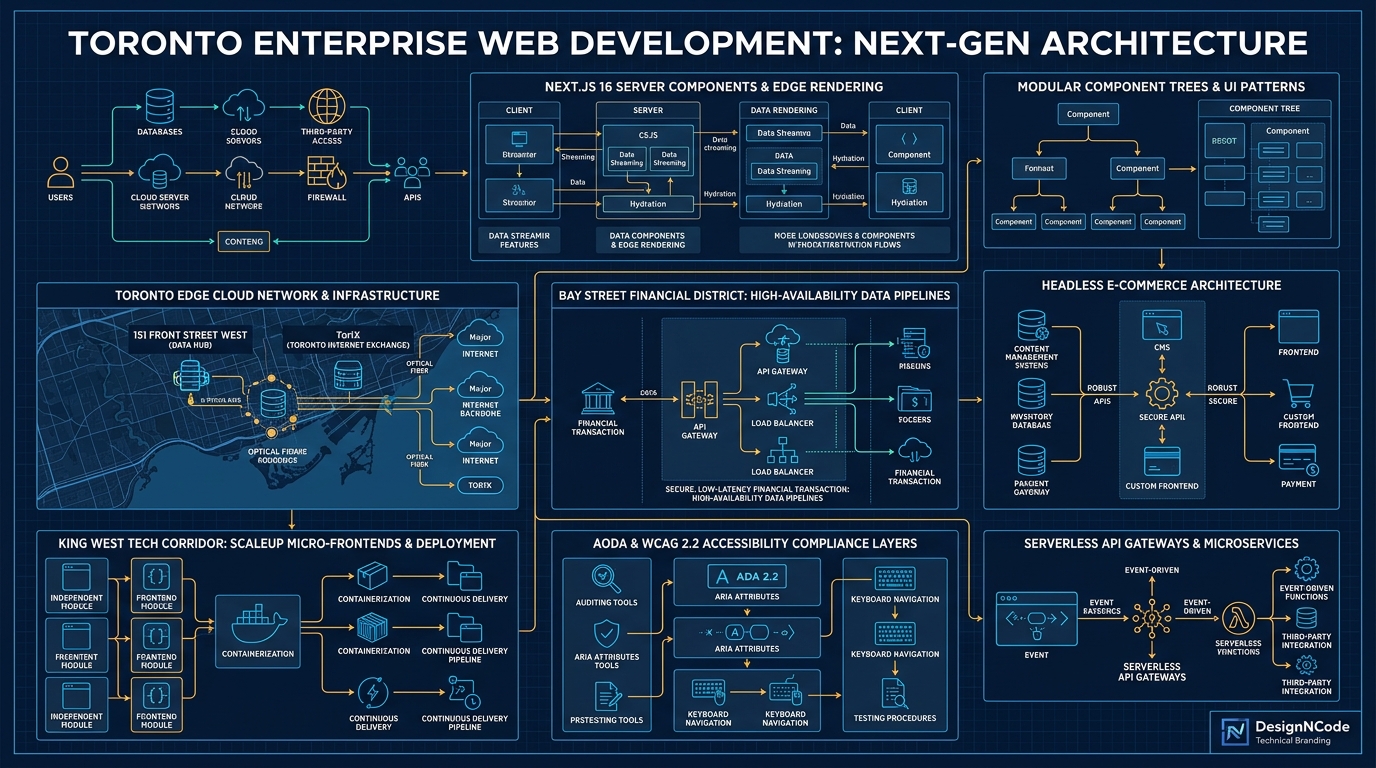
5. Bloor-Yorkville Luxury Commerce & Headless Digital Storefronts
Premier luxury flagships, artisanal jewellery houses, and high-end fashion retailers throughout Bloor-Yorkville and Yorkdale require digital storefronts that reflect the prestige of physical retail salons. Traditional template-based e-commerce platforms constrain brand expression through rigid themes, slow catalog browsing, and disconnected checkout journeys. High-net-worth international clients expect fluid animations, high-resolution media galleries, and private transactional security. High-end digital commerce requires tailored engineering that strengthens brand value while maintaining rapid performance across global markets.
We develop headless luxury e-commerce platforms that combine our bespoke UI/UX design services with scalable Shopify and e-commerce development backends. By decoupling the presentation layer from inventory databases via GraphQL APIs, we construct interactive product customizers, VIP booking workflows, and localized multi-currency checkout funnels. Our hardware-accelerated image pipelines ensure visual storytelling loads instantaneously, helping Toronto luxury brands build client loyalty and maximize average order values.
6. AODA & Accessible Canada Act WCAG 2.2 AA Compliance Governance
Digital accessibility represents an essential software quality standard and a mandatory legal obligation under the Accessibility for Ontarians with Disabilities Act and the Accessible Canada Act. Enterprise web applications must provide universal access to all users, regardless of visual, physical, auditory, or cognitive capabilities. Relying on superficial third-party accessibility overlay widgets fails legal compliance checks and exposes commercial enterprises to substantial regulatory penalties. Digital platforms must incorporate accessible markup, semantic document structures, and proper ARIA live regions directly within source code.
DesignNCode integrates digital accessibility into every stage of the engineering lifecycle, developing digital platforms that strictly satisfy AODA Compliance Guidelines and W3C WCAG 2.2 Standards. We execute automated accessibility linting suites, conduct manual audits with VoiceOver and JAWS screen readers, and verify color contrast ratios across dynamic user states. By engineering keyboard navigation traps for complex modal dialogs, our engineers ensure Toronto enterprises provide inclusive experiences while eliminating regulatory liability.
7. Generative Engine Optimization, Search Dominance & Core Web Vitals
Achieving dominant organic search visibility across competitive Toronto enterprise sectors requires web development aligned with modern search engine algorithms and Generative Engine Optimization criteria. Contemporary search engines and AI assistants prioritize rich semantic markup, dense factual content structures, and superior Core Web Vitals performance. Websites burdened by sluggish server response times, high client execution latency, and missing structured schemas experience severe algorithmic penalties, forfeiting high-value commercial leads to digitally optimized market competitors.
Our full-stack engineers embed multi-entity JSON-LD structured schemas, server-side metadata generation, and automated sitemap pipelines into every Next.js build. Blending modern frontend engineering with strategic SEO services, we ensure complete indexing across algorithmic search bots and conversational AI models. We optimize Largest Contentful Paint and Interaction to Next Paint to sub-second standards, enabling Toronto organizations to capture qualified commercial traffic and convert visitors into valuable business inquiries.
8. Enterprise Omnichannel Integration & Scalable API Architecture Strategy
Modern enterprise web applications must serve as unified digital control centers orchestrating communication between customer relationship management tools, marketing automation platforms, inventory databases, and client support channels. For Toronto corporations managing offices across North America, disconnected software systems create operational bottlenecks, delayed reporting, and inconsistent customer interactions. Robust web architectures require resilient API middleware, asynchronous event queues, and secure webhook listeners to ensure reliable bidirectional synchronization across enterprise software layers.
We engineer cohesive digital ecosystems that connect high-performance frontend interfaces with business-critical backend applications and dynamic performance marketing systems. By structuring clean RESTful and GraphQL endpoints, our development teams guarantee data flows securely across corporate departments in real time. To discover how our senior engineering team can architect your next mission-critical web application, read about our team or contact our engineering team today to schedule an initial technical discovery session.
Client Reviews: Toronto
"DesignNCode re-architected our institutional wealth management portal in the Bay Street financial core. Their implementation of Next.js server components, OSFI B-13 compliance, and TorIX edge routing reduced our platform response times by 68% and dramatically accelerated client onboarding across Canada."
Marc Tremblay
Chief Technology Officer, Apex Capital Partners (Bay Street, Toronto)
"Scaling our King West software platform required a composable micro-frontend system that could keep pace with our growing engineering squads. Ankita Malik and the DesignNCode team engineered a high-velocity modular framework that doubled our release speed while maintaining flawless AODA accessibility."
Claire Laroche
VP of Engineering, Veloce Cloud Systems (King West, Toronto)
Frequently Asked Questions
Why choose Next.js 16 for enterprise web applications in Toronto?+
Next.js 16 leverages React Server Components, streaming hydration, and edge execution to deliver sub-100ms response times. By moving computational overhead off consumer hardware, Next.js maximizes conversion throughput and organic search visibility across competitive Canadian commercial markets.
How do you ensure web applications satisfy mandatory AODA and WCAG 2.2 AA standards?+
We construct native semantic markup, compliant ARIA attributes, logical keyboard focus traps, and automated linting suites from the initial sprint. Every digital interface undergoes rigorous screen reader verification to ensure total statutory protection under Ontario provincial accessibility regulations.
What infrastructure strategy guarantees ultra-low latency across the Greater Toronto Area?+
We deploy edge computing layers directly adjacent to the Toronto Internet Exchange at 151 Front Street West. Utilizing automated asset compression, Brotli encoding, and CDN edge caching, our web applications resolve critical payloads with instantaneous sub-second precision.
How do your architectures maintain OSFI B-13 and PIPEDA compliance for financial portals?+
We implement zero-trust authentication models, automated cryptographic key rotation, explicit user consent pipelines, and tamper-proof audit trails. Our engineering frameworks safeguard sensitive financial data and insulate Bay Street institutions against evolving cybersecurity threats.
Can you modernize monolithic web applications without interrupting business operations?+
Yes, we execute phased strangler fig migrations by deploying modern API gateways in front of existing infrastructure. We systematically replace legacy modules with high-speed Next.js micro-frontends, preserving operational continuity and preventing commercial revenue disruption.
How do you scale frontend development velocity for King West tech scaleups?+
We build modular micro-frontends and shared design token registries powered by TypeScript and automated CI/CD deployment pipelines. This architecture enables multi-squad development teams to ship isolated features rapidly without merge conflicts or systemic regressions.
What architecture powers headless e-commerce for Bloor-Yorkville luxury retailers?+
We decouple bespoke Next.js frontends from enterprise e-commerce engines like Shopify Plus using GraphQL APIs. This setup delivers cinematic product visualizers, private VIP client reservation workflows, and instantaneous multi-currency checkout experiences tailored for discerning luxury shoppers.
What is the standard engagement timeline for enterprise web development in Toronto?+
Our enterprise engagements typically range from six to twelve weeks, covering technical discovery, system architecture, sprint engineering, accessibility verification, and zero-downtime deployment. We maintain transparent sprint demonstrations, staging previews, and comprehensive technical documentation throughout.
Authoritative Sources & Citations
The regulatory, technological, and architectural standards referenced across this publication.
Mandatory provincial accessibility requirements and digital compliance standards for Ontario organizations.
International criteria defining accessible color contrast, keyboard navigation, and screen reader semantics.
Federal legislation governing commercial user consent architecture and consumer data protection.
Regulatory expectations for technology risk management, cybersecurity resilience, and operational integrity.
Technical routing standards governing low-latency metropolitan data exchange at 151 Front Street West.
Modern framework standards for React Server Components, streaming rendering, and layout shift mitigation.
